


Generalveiled
Everyday browsing, carried in company.
VPN · Active Privacy
Privacy is not a privilege
Everyone else hides where you go.
Ghost hides when you were there.
A VPN that never breaks the sites you're signed into and never learns your name.
Presented by Philosophical AI
Secure browsing through
Active Privacy
The instrument
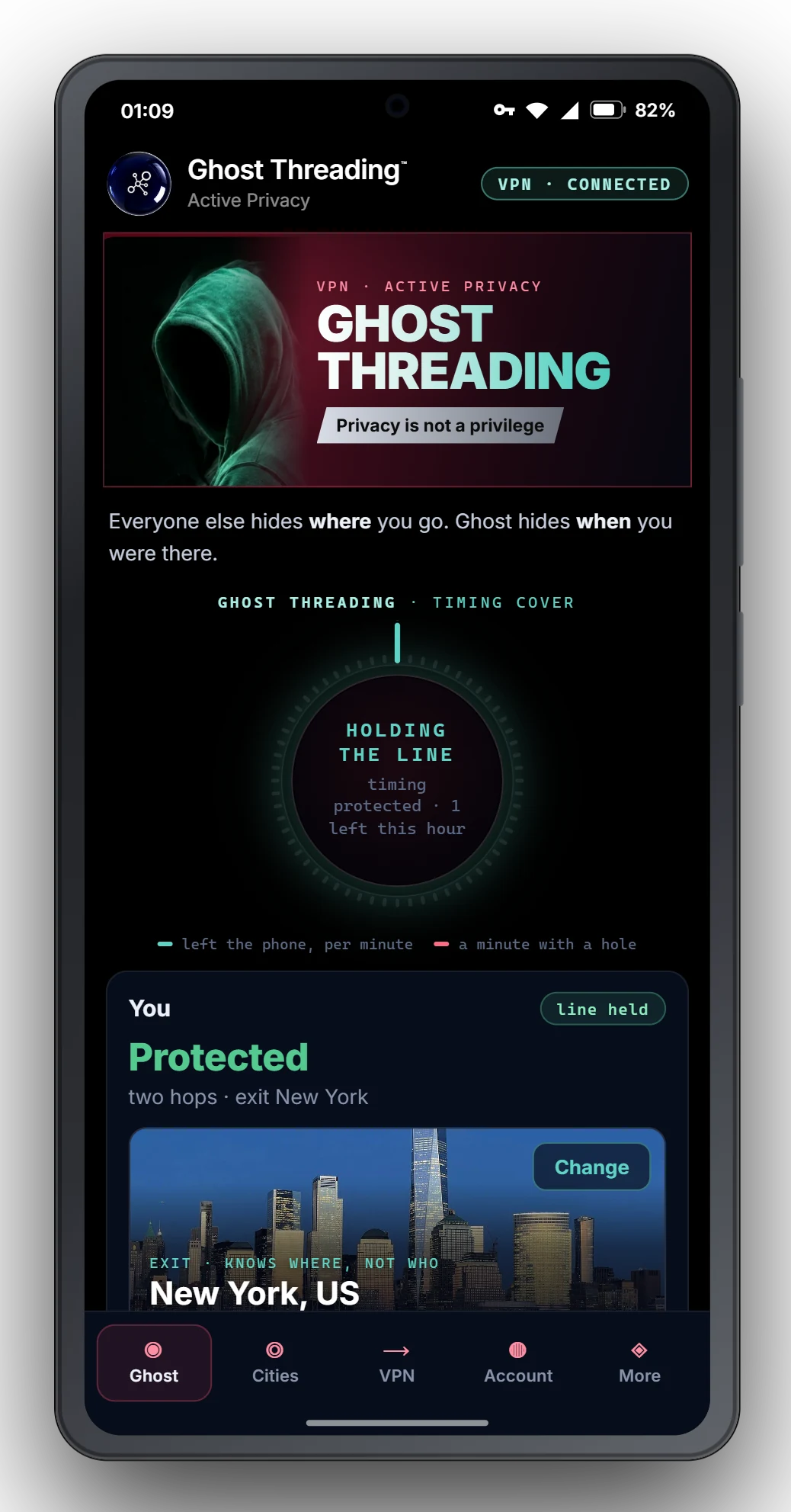
Not a mock-up. A real screen, connected and holding the line. One thing moves on it, and it is data.

Speed · live
Tested at launch, either side of connecting, at disconnect and whenever you ask; the last three kept, the tunnel's cost printed beside it. Never a number we didn't measure.
Holding the line
The ring is the last hour of your line, a minute at a time. A crimson notch is a minute with a hole in it, and Ghost shows you.
Said plainly
VPN · connected, and the city you exit from, in words. No shield icon to guess at, no flag in a list of a hundred flags.
The problem
Someone watching your front door can't see inside. But they see exactly when you leave and exactly when you come home.
Your connection works the same way. A VPN hides where you went. The moment you did it still shows. That timing is what has actually unmasked people. Not codebreaking. Coincidence.
What a VPN still shows
What an observer looks for
Every time you open a page, your connection sends a burst, and the site receives one at the same moment. An observer who can see both doesn't need to read a word. If the bursts line up, again and again, the two belong together.
That's why Ghost never goes quiet. Your line stays busy all the time, so your bursts don't stand out to be matched.
Your connection
The site you visit
The wire · what an observer on your line sees
a page opens on a VPNGhost, never quiet
A VPNsilent until a page opens
Ghostnever quiet
An illustration. A page opens every few seconds. On a VPN, each one is a burst on a silent line, easy to timestamp. On Ghost, the line is never quiet and the page load disappears into it. The measured version, from Windows' own packet capture, is right below.
Measured on the wire
The drawing above is an illustration. This is the real thing: Windows' own packet capture of Nord's tunnel and Ghost's, over the same three idle minutes on the same machine, with a page opened at 120 seconds, at the red line.
On the wire, three idle minutes
4.1×
Ghost 91,438 packets · Nord 22,508 · same machine, same minutes, each tunnel counted from the capture
What the beat costs
2%
252 Mbps with the beat off, 247 Mbps with it on · the same probe on the same tunnel
From Connect to protected
1.5s
service start to exit address confirmed · no account call

0 s30 s60 s90 s120 s150 s180 s

0 s30 s60 s90 s120 s150 s180 s
What this shows. The beat is real, it runs inside the tunnel, and it never stops: every timing case on record needed a line that went quiet between a connect and an act, and this one does not. The extra 68,930 packets are plausible page fetches in a steady rhythm, with the user's own page load somewhere inside them.
Said carefully. Both lines were captured on a working machine with other software talking in the background, so Nord's line is busier here than a truly idle line would be; the comparison is like for like, not a photograph of silence.
How it works
A light, steady beat of traffic runs whether you're there or not. No "started at 8 pm, stopped at 11." No beginning, no end, nothing to line up against anything else.
The cover is real. Others fill the silence with dummy packets. Ghost's beat is real pages from real sites.
The idea · three things, in order
Why a VPN with threading beats a VPN, and beats Tor, on the threats that have actually closed cases.
The route
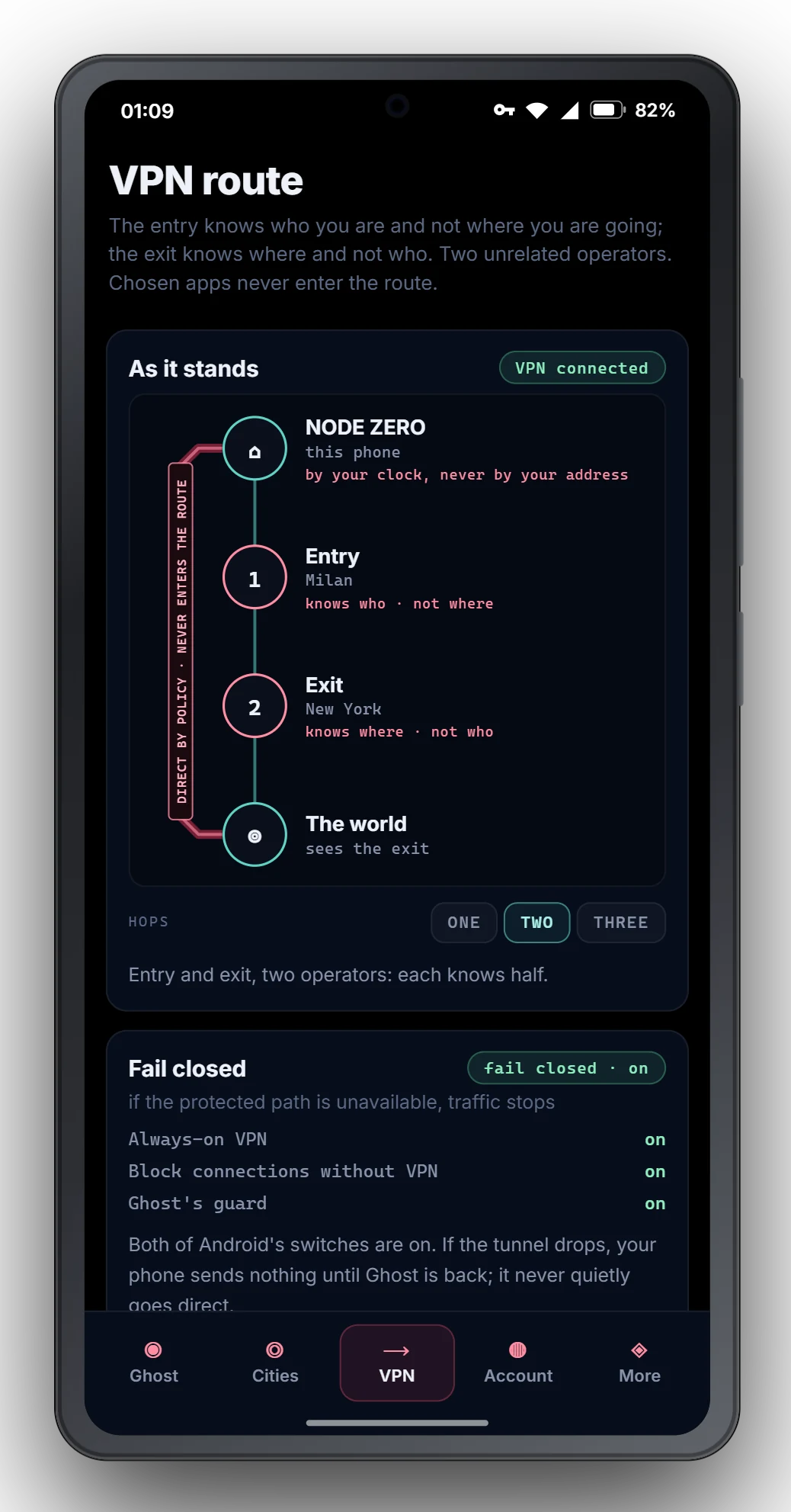
Hiding from it protects nothing and breaks the login. So Ghost sends it straight through, on purpose, and keeps the route for everything else.
Two hops shown, on two companies. Ghost also offers one relay, by your choice, and while that route is on it says "knows who and where" on every screen, like any VPN would have to. Node Zero, your machine, is never on any map.
Generalveiled
Everyday browsing, carried in company.
Socialveiled
Its own circuit, its own city if you pin one.
Streamingveiled
Pinned where the catalogue lives. It stays there.
Bankingdirect by policy
You, then the site, directly. Circuit actions refused: identified.
Rules the route keeps
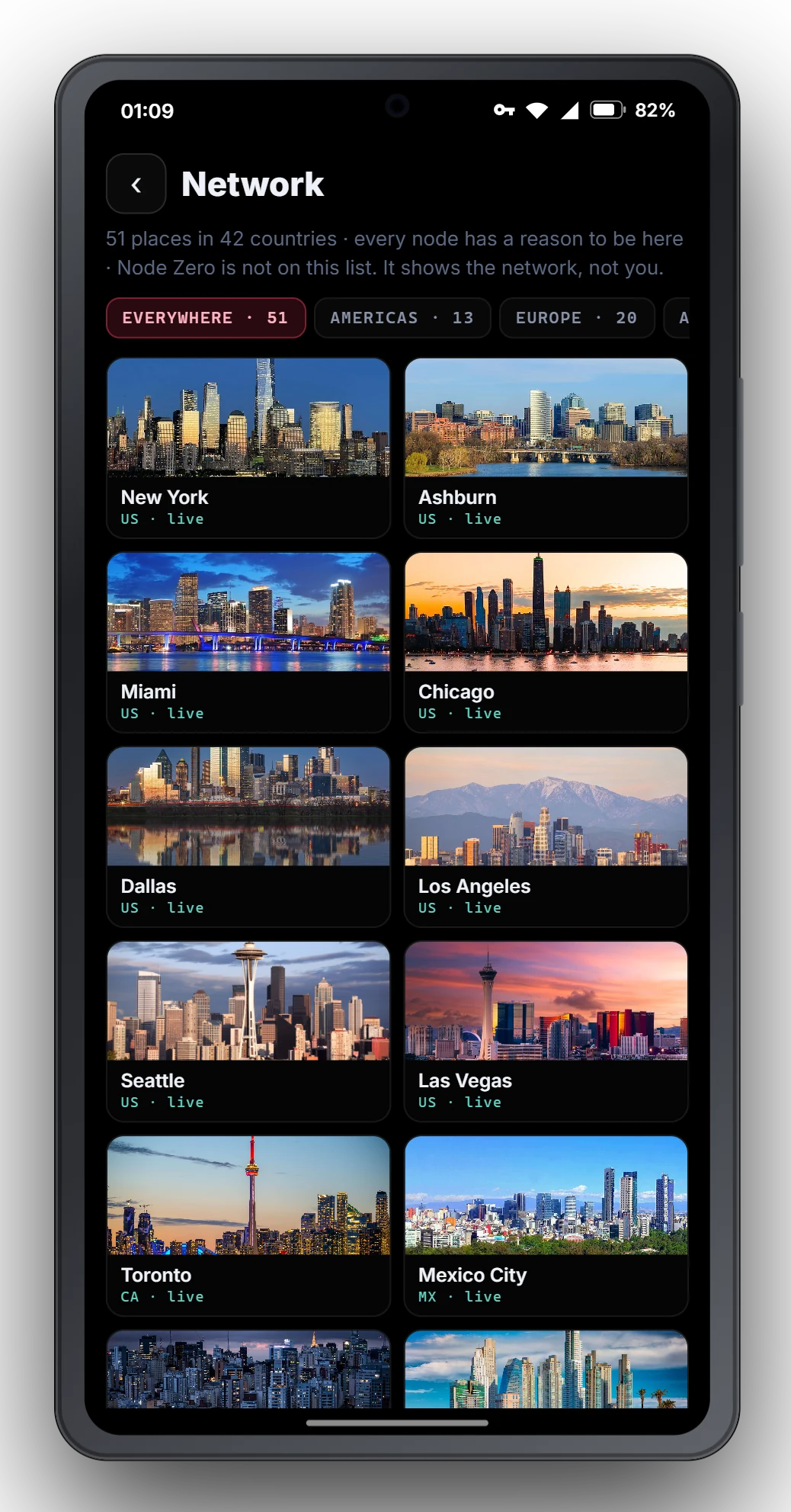
The network
Pinned per activity, not per machine: your legal work stays in New York while everything else keeps moving. If that city goes away, the thread stops rather than slip somewhere else. Every node has a reason to be here.

Node Zero, your machine, is not on this map.
The guard
Relay blocking · on
More than 127,000 known phishing, ransomware and scam domains are turned away before they ever reach your machine. Other VPNs sell this as an extra. With Ghost it's in the price.
It has to be your choice, so it's a plain switch on the main screen: on, or off. No warning voice when you turn it off.
How it compares
Against the two biggest VPNs and the most private one. Mullvad is a privacy-focused provider with a strong reputation for protecting its customers, and we respect its approach. Here's what each of them offers, what Ghost offers, and where the technologies differ, including where they're ahead.
| What you actually want | NordVPN | Surfshark | Mullvad | Ghost Threading |
|---|---|---|---|---|
| Hides your address from the sites you visit | YesFrankfurt exit, measured | YesMilan exit, measured | Yesnot measured here | YesNuremberg relay · ipleak.net agrees |
| Keeps your DNS lookups inside the tunnel | Yesits own resolver, measured | Yesits own resolver, measured | Yesits own resolver | Yesthe relay itself answers · dnsleaktest.com: one server, six rounds |
| Leaks nothing over IPv6 or WebRTC | Yesmeasured | Yesmeasured | Yesnot measured here | Yestest-ipv6.com and browserleaks.com agree |
| Blocks phishing, scam and malware sites | Yesin its plans | Yesin its plans | YesDNS content blocking | Yesrefused at the relay · yours to switch off |
| Speed on the tunnel | 255 Mbpsmeasured | 272 Mbpsmeasured | not measured | 252 Mbpsparity, measured |
| Time from Connect to protected | 4.3 sto Frankfurt | 1.7 sto Germany | not measured | 1.5 sto Nuremberg · no account call |
| Knows who you are | Yesemail and payment identity | Yesemail and payment identity | Noa random account number | Noa random credential, no email, no name |
| What a court order can get from them | Your recordemail, payments, plan, tickets | Your recordemail, payments, plan, tickets | A number and a date | A record that names nobodyand holds no traffic |
| Keeps traffic logs | Nopolicy audited by Deloitte | Nopolicy audited by Deloitte | Noindependently audited | Nonever written, by construction |
| Hides when you act, not only where | None documented | None documented | PartlyDAITA, opt-in: dummy packets and padding | Yesa beat of real page fetches, 2 % of speed |
| Apps for Windows, Mac, iPhone, Android, Linux | Yes | Yes | Yes | Windows, Android and Linux |
| Countries to choose from | Far more | Far more | not compared | 51 citiesin 42 countries |
| Price | Less on a two-year planrenews higher, per its own pricing page | varies by plan length | €5 a month, flatcash and Monero accepted | First month freethen $9.95, month to month |
Every app measured by us with the same tests, on the same machine and connection, in September and October 2026, pressing each app's own Connect button. Leak verdicts come from public test sites, not from us. "None documented" means we found no such feature in their published documentation; it does not mean we proved it absent. Competitor prices and audits from their own sites, October 2026.
| What you actually want | VPN alone | Tor | Ghost Threading |
|---|---|---|---|
| Hides your address from the site you visit | Yes | Yes | Yes. In the city you chose, over one, two or three hops |
| Hides when you were online | No. The tunnel goes up and down with you | No | Yes. The line is never quiet |
| Defeats an observer counting request timing and size | No | Partly | Yes, at the level that has closed real cases: presence and rhythm |
| Requires trusting a single company | Yes. One provider sees who and where | Partly. Volunteer entry and exit | No. Two unrelated operators; each knows half |
| Survives one operator being breached or compelled | No | Partly | Yes. One order reaches one half, and there are no logs on either |
| Breaks logins, banking, streaming | Frequently | Usually | No. Identified sessions route direct by policy |
| Lets you choose a city and keep it | Yes, for the whole machine | No | Yes, per thread, pinned, never moves |
| Effect on speed | Slower | Much slower | One to three hops, your choice. Measured on the scorecard, never claimed |
| Records of your traffic | None at the audited ones | None | Never written. Billing only, and the policy names it |
| Protects you on a network you do not control | Yes | Yes | Yes |
Why both, in one product. A VPN alone hides where you are and leaves when you were there in plain view. Threading alone hides the pattern and leaves your address on every packet. Ghost runs both under one controller with the same rules for each: fail closed, direct only by policy, budgeted change, no signature.
Independent verdicts · not our probe, not our words
Ghost connected through Nuremberg.
Where the others are ahead
A company confident enough to tell you when a competitor might suit you better is a company worth trusting.
If what you need is to hide when you were online, and not only where, there's one product built for it.
No name
A Ghost account is a paid entitlement, not a person. No name, no address, no email, no identity profile. A random credential is the account.
Other VPNs offer to watch your Social Security number. Ghost never learns your name.
Your Ghost credentialsample
GHOST-4QZ7-•••••-•••••-••••7-K2
On your card statement
PAI* GHOST 7K4P2M
Never written
Ghost does not log what you do. Not which sites, not which pages, not when, not from where, not your DNS. Not on the entry relay, not on the exit relay, not on your machine, not on ours. These records are not deleted after your session. They are never written.
What does exist, and why
When the law comes
Measured
The same tests, the same clock, for everyone. Ghost against the two biggest VPNs in the world.
From Connect to protected · press to confirmed exit
NordVPN
4.3s
to Frankfurt · its own "Secure my connection"
4.354.204.264.374.50
Surfshark
1.7s
to Germany · its own "Quick-connect"
1.351.271.651.882.80
Ghost fastest
1.5s
to Nuremberg · the service start command
1.331.571.491.780.78
Why Ghost is quick. Pressing Connect starts the tunnel on your machine, does one handshake with the relay, and runs one request through the tunnel to confirm the exit. No login, no server list to ask for, no keys to fetch, because the account is a random credential that never speaks on connect. The number is the design made visible.
Said carefully. Surfshark is in the same breath; Nord is not. We measured what their apps do from the outside and nothing more. What happens inside their connect sequence is their business; what we claim is ours: no account step exists to slow Ghost down, and the clock agrees.
| Measured | Bare line | Surfshark · Milan | Nord · Frankfurt | Ghost · Nuremberg |
|---|---|---|---|---|
| Throughput, median | 224 Mbps | 272 Mbps | 255 Mbps | 252 Mbps |
| With the timing cover running | — | — | — | 247 Mbps |
| Latency to Cloudflare, by name | 135 ms | 188 ms | 253 ms | 191 ms |
| Who answers your DNS | your router's choice | their own resolver | their own resolver | the relay itself |
| IPv6 leak | none | none | none | none |
| Traffic on the wire while you're idle | nothing | nothing | nothing | a continuous beat |
Method: each app's own Connect button, timed from the press until the exit address changed, the median of repeated presses; Ghost timed from its service start. Throughput: the same probe for every app, the median of repeated pulls. Every app measured by us on the same machine and connection, September and October 2026. The timing cover cost two percent of throughput, inside the line's own noise. Site blocks follow the exit address as much as the product.
Also on Android
Your Ghost credential is your account. Enter it once and the phone keeps it sealed in its own keystore: no name, no email, no phone number. Then the same line, the same cities and the same route as on your computer.
Price
No contracts. No lock-in. It runs month to month until you cancel, and you cancel with the code on your card statement. You pay us to protect you, and that's the whole business.
What you won't find here
Ghosteverything included
First month free
$9.95/ month after
month to month · until you cancel · no contracts
We won't ask for your email, not even for a waiting list. Check back.
What it does not do said in the same voice